
Scale Readiness: The 5 Systems Every £1M+ Business Needs
Before you add headcount or chase the next revenue stage, five systems decide whether growth compounds or collapses into chaos. This guide shows CEOs and their leadership teams how to test for each one, what good looks like, and the order to build them in.

By Gideon, Founder, Markinly International Management — fractional COO to $1M–$20M businesses across the UK, US and Europe, with 20+ years of operational leadership.
How to use this guide
This is a diagnostic and a specification, not a motivational read. Use it to find out which of the five systems your business is missing, what each one must contain to work, and what it costs you while it is missing.
Who it is for. CEOs, managing directors and leadership teams of businesses turning over roughly £1M to £20M, typically 10 to 150 people. Below that, most of this is premature. Above it, you likely have these systems and need the next layer: planning cycles, portfolio governance, formal management development.
How to read it.
-
Read Why growth breaks businesses (two pages). It explains why the problems you are feeling are structural, not personal.
-
Take the Scale Readiness Scorecard with at least two members of your leadership team, scoring separately. The gaps between your scores are often more revealing than the scores themselves.
-
Read the system chapters in order of your lowest scores, not in page order.
-
Use the 90-day build sequence to decide what to start this quarter, and the margin-leakage worksheet to put a number on the cost of waiting.
What each system chapter gives you. Every chapter follows the same structure so your team can compare like with like:
| Part | What it answers |
|---|---|
| The job it does | Why the business needs this system at your stage |
| Warning signs | The symptoms that show it is missing or broken |
| The specification | What the system must contain to work — the minimum standard |
| How to build it | The build steps, in order |
| Calibrate to your stage | What changes at £1–3M, £3–10M and £10–20M |
| Measures | How you will know it is working |
| Common mistakes | Where well-run businesses still get it wrong |
A word on honesty. Every system in this guide looks simple on paper. None of them is simple to embed. The tools take a weekend to set up; the behaviour change takes a quarter. Most stalled implementations we see failed on ownership and rhythm, not on design. Plan for that from the start.
Why growth breaks businesses
Growth does not break businesses because people get worse. It breaks them because informal systems have a carrying capacity, and growth quietly exceeds it.
In a business of eight people, communication works because everyone overhears everything. Pricing works because one person holds it in their head. Quality works because the CEO sees every piece of work before it leaves. None of that is a system; it is proximity. Proximity does not scale.
The carrying-capacity problem
Every informal arrangement has a point where it fails:
-
Communication that works in one room fails across two teams, two offices or two time zones.
-
A pricing sheet one person understands becomes a liability the moment three people are quoting from it.
-
Quality control by the CEO’s personal review becomes the bottleneck the moment volume exceeds what one person can check.
-
Priorities set in hallway conversations become contradictory the moment there are more managers than hallways.
The failure is rarely dramatic. It shows up as friction: work redone, clients chasing, good staff frustrated, margins thinning without an obvious cause. Leadership teams usually diagnose it as a people problem. It is almost always a systems problem wearing a people costume.
The stage thresholds
In our experience, operating models break at predictable headcount bands. The exact numbers vary by sector and by how distributed the team is, but the pattern is consistent:
| Headcount (approx.) | What stops working | What the next stage needs |
|---|---|---|
| ~5 | The owner doing and checking everything | First delegation; basic task tracking |
| ~15 | Everyone knowing what everyone else is doing | Visible work management; a weekly meeting |
| ~30 | The CEO as the router of every decision | Written decision rights; a management layer that owns outcomes |
| ~50 | Processes living in people’s heads | Documented core processes; formal onboarding; a scoreboard |
| 50+ | One leadership team holding all the context | Departmental rhythms that feed a leadership rhythm |
Each stage invalidates the operating model of the stage before it. The habits that got you to 15 people are the habits that will stall you at 30.
What unreadiness costs
The cost of arriving at a stage without its systems is real but hidden, because it rarely appears as a line on the P&L. It appears as:
-
Margin leakage — scope given away, work redone, under-quoted jobs, unbilled time.
-
Capacity loss — senior people doing junior work because nobody else knows how.
-
Owner dependency — growth capped at the CEO’s personal bandwidth, and an enterprise value discounted by any acquirer who sees it.
-
Staff churn — capable people leave chaotic environments first, because they have options.
The margin-leakage worksheet later in this guide lets you put your own numbers on these.
What scale readiness means
Scale readiness is building the next stage’s systems before you arrive there. Not after the first client complaint, the first key resignation, or the first quarter where revenue grows and profit falls. The five systems in this guide are the minimum operating infrastructure that lets a £1M+ business grow without the CEO becoming the ceiling.
The Scale Readiness Scorecard
Score each statement from 0 to 4 based on what is true today, not what is planned. Have your leadership team score independently, then compare. Where two people differ by two points or more, you have found a conversation you need to have.
Scoring: 0 = not true at all · 1 = true occasionally · 2 = true about half the time · 3 = true most of the time · 4 = always true, and we could prove it
System 1 — Sales-to-delivery handover
| # | Statement | Score (0–4) |
|---|---|---|
| 1.1 | Every closed deal produces a written handover before delivery starts. | |
| 1.2 | Delivery can state the agreed scope, price and client expectations without asking sales. | |
| 1.3 | Each client has one named delivery owner from day one. | |
| 1.4 | We know what percentage of projects or accounts go over scope, and why. | |
| 1.5 | Delivery problems feed back into how we sell and quote. | |
| System 1 total (max 20) |
System 2 — Visible work management
| # | Statement | Score (0–4) |
|---|---|---|
| 2.1 | All work in progress lives in one system, not in inboxes and chat threads. | |
| 2.2 | New requests come in through a single intake route. | |
| 2.3 | Every task has one owner and one due date. | |
| 2.4 | A manager can see team capacity for the next two weeks in under five minutes. | |
| 2.5 | When priorities clash, a named person decides — and the decision is recorded. | |
| System 2 total (max 20) |
System 3 — Documented core processes
| # | Statement | Score (0–4) |
|---|---|---|
| 3.1 | Our five most important workflows are written down. | |
| 3.2 | The documentation is current — reviewed in the last six months. | |
| 3.3 | New hires are trained from the documentation, not just by shadowing. | |
| 3.4 | Two different people doing the same process get the same result. | |
| 3.5 | Each core process has a named owner responsible for keeping it current. | |
| System 3 total (max 20) |
System 4 — The weekly operating rhythm
| # | Statement | Score (0–4) |
|---|---|---|
| 4.1 | The leadership team meets weekly, at a fixed time, with a fixed agenda. | |
| 4.2 | The meeting starts with numbers, not anecdotes. | |
| 4.3 | Commitments made in the meeting are recorded and checked the following week. | |
| 4.4 | Problems are surfaced early rather than discovered late. | |
| 4.5 | The meeting runs to time and still happens when the CEO is away. | |
| System 4 total (max 20) |
System 5 — Decision rights
| # | Statement | Score (0–4) |
|---|---|---|
| 5.1 | There is a written list of decisions managers can make without the CEO. | |
| 5.2 | Spending limits are defined by role. | |
| 5.3 | Staff can resolve routine client issues and concessions within set limits. | |
| 5.4 | The CEO could take two weeks off without decisions queuing up. | |
| 5.5 | Decisions made below the CEO are rarely overturned. | |
| System 5 total (max 20) |
Reading your score
Add the five system totals for an overall score out of 100. Then look at the lowest system score — it matters more than the overall total, because one broken system drags down the other four.
| Overall score | What it means | Where to focus |
|---|---|---|
| 0–39 | Owner-dependent. The business runs on the CEO’s memory and attention. Growth will add chaos faster than revenue. | Systems 2 and 4 first: make work visible and install the weekly rhythm. |
| 40–59 | Fragile. Some systems exist but depend on individuals. Growth is possible but expensive; expect margin erosion. | Your two lowest-scoring systems, with a named owner for each. |
| 60–79 | Functional. The basics work. The constraint is consistency and the CEO’s remaining involvement in routine decisions. | Systems 3 and 5: document and delegate. |
| 80–100 | Scale-ready. The business can absorb the next stage of growth. Your job is maintenance and the next layer of maturity. | Quarterly audits; build the next stage’s systems ahead of time. |
One more rule. Any single system scoring below 8 out of 20 is a priority regardless of your overall total. A business scoring 75 overall with a decision-rights score of 6 is still owner-dependent.
System 1 — Sales-to-delivery handover
The most expensive gap in most growing businesses sits between the promise and the delivery. A defined handover — what was sold, at what scope, with what expectations, owned by whom — stops the rework and scope drift that quietly consume margin.
The job it does
Sales is paid to close. Delivery is measured on doing the work well. Without a formal handover, the two optimise against each other: sales makes promises delivery never heard, and delivery fills the gaps with guesswork. The client experiences this as the moment the business stopped listening — usually in the first two weeks.
The handover turns a verbal promise into an operational commitment that someone owns.
Warning signs
-
Delivery teams regularly say “that’s not what I was told.”
-
The first client call after signing involves re-explaining what was agreed.
-
Projects routinely run over budgeted hours, and nobody can say which part of the scope caused it.
-
Clients get “extras” because nobody knew they were extras.
-
The CEO or the salesperson stays involved in delivery “to keep the client happy.”
-
Invoices are disputed because the client remembers a different agreement.
The specification
A working handover system has three components.
1. One handover document per closed deal. It is a short, fixed template — not a narrative — completed by the person who sold the work before delivery starts. Minimum contents:
| Field | What it captures |
|---|---|
| Client and decision-maker | Who signed, who the day-to-day contact is, who else influences |
| What was sold | Deliverables, quantities, service level, in the client’s language |
| What was explicitly excluded | The things the client asked about that are not included |
| Commercials | Price, payment terms, any discounts and the reason for them |
| Promises made | Dates, response times, named people — anything said that sounds like a commitment |
| Client’s definition of success | What they will judge you on, in their words |
| Risks and sensitivities | Previous bad experience, internal politics, deadlines driving the purchase |
2. A handover meeting before kickoff. Fifteen to thirty minutes between the seller and the delivery owner. The delivery owner reads the document first and arrives with questions. The meeting ends with three things agreed: the named delivery owner, the scope as delivery understands it, and the first-week plan.
3. A feedback loop from delivery to sales. Every month, delivery reports on the gap between what was sold and what was needed: scope added, hours over, assumptions that proved wrong. Sales and leadership use that to adjust proposals, pricing and qualification. Without this loop the handover documents the problem but never fixes it.
How to build it
-
Pull your last ten closed deals. For each one, ask delivery what they wish they had known on day one. The answers are your template fields.
-
Draft a one-page handover template. Keep it to what delivery genuinely needs. If it takes longer than 20 minutes to complete, salespeople will stop doing it.
-
Make it a gate, not a request. In your CRM or work management tool, a deal cannot move to “in delivery” until the handover is attached. Commission or bonus payment can reasonably depend on it.
-
Run the handover meeting for every new client for one quarter. Then decide whether smaller deals can use the document alone.
-
Install the monthly feedback review. Put it on the leadership agenda; track scope-creep hours per client.
Calibrate to your stage
| Stage | What it looks like |
|---|---|
| £1–3M | The CEO often sells and delivery is two or three people. A shared template and a 15-minute call are enough. The discipline is writing it down at all. |
| £3–10M | Separate sales and delivery roles. The template becomes a required CRM stage. Monthly scope-variance review starts. |
| £10–20M | Multiple sellers and delivery teams. Add a quality check on handover completeness, and include scope variance in sales performance reviews. |
Measures
-
Percentage of new clients with a completed handover before kickoff (target: 100%).
-
Hours or cost delivered beyond sold scope, per client, per month.
-
Number of “that’s not what we agreed” escalations in the first 30 days.
-
Time from signature to kickoff.
Common mistakes
-
A template so long nobody fills it in. One page. Add fields only when their absence has caused a problem.
-
Treating the handover as a sales admin task. It is a delivery input. Delivery should be able to reject an incomplete handover.
-
No feedback loop. Without it you document scope creep forever instead of reducing it.
-
Letting the seller stay as the client’s main contact. A warm transfer is good; a permanent dependency is not.
System 2 — Visible work management
One place where all work in progress lives. ClickUp, Monday.com or Asana — the tool matters far less than the discipline around it. Structured intake replaces requests-by-chat; capacity becomes visible; priorities become decisions rather than accidents.
The job it does
When work is invisible, three things happen. Managers cannot see who is overloaded until someone burns out or a deadline is missed. Priorities are set by whoever shouts loudest or messages last. And the CEO becomes the only person who knows the true state of the business, because they are the only person in every conversation.
Visible work management makes the state of the business inspectable by anyone with the right access, at any time, without a meeting.
Warning signs
-
“Can you just quickly…” requests arrive by WhatsApp, Slack, email and in the corridor.
-
Nobody can answer “what is the team working on this week?” without asking around.
-
Deadlines are missed and the first anyone hears of it is the client.
-
The same people are always overloaded while others have slack.
-
You have a project management tool, but half the team does not use it and the other half keeps a parallel spreadsheet.
-
Status meetings exist mainly to find out status.
The specification
1. A single intake channel. Every request for work — from clients, colleagues or leadership — enters through one route: a form, a dedicated board, or a request queue. Requests outside the channel are redirected, politely and every time. This is the hardest habit in the guide and the one that pays back fastest.
2. One owner, one due date. Every task has exactly one person accountable for it and one date. “The team” is not an owner. “ASAP” is not a date. Shared ownership means no ownership.
3. A small, consistent set of statuses. For example: Not started · In progress · Waiting on someone · In review · Done. Five or fewer. If you need more, the workflow belongs in System 3.
4. A leadership view. One dashboard showing, for each team: capacity versus load for the next two weeks, overdue items, items blocked for more than three days, and the top priorities. This is what the weekly meeting (System 4) reviews.
5. A priority rule. When two requests compete, who decides? Write it down: usually the team lead, escalating to a named director only when the conflict crosses teams.
How to build it
-
Choose one tool and commit. If you already pay for one, use it. Switching tools rarely fixes a discipline problem.
-
Design the structure on paper first. Which boards or spaces (usually by team or by client), which statuses, which fields. Keep it minimal; you can add later.
-
Build the intake form. Required fields: what is needed, by when, for whom, and why. Optional: attachments, links.
-
Migrate live work only. Do not import history. Put every active task into the system with an owner and date, in one session per team.
-
Set the rule and enforce it for 30 days. “If it’s not in the system, it doesn’t exist.” Leaders go first: the CEO’s requests go through intake too.
-
Build the leadership view once the data is reliable — usually after four to six weeks.
Calibrate to your stage
| Stage | What it looks like |
|---|---|
| £1–3M | One workspace, one board per function or client. Intake can be a simple form. The CEO’s own requests are the real test. |
| £3–10M | Team-level boards, a cross-team portfolio view, automations for intake routing and overdue alerts. Capacity planning becomes weekly. |
| £10–20M | Formal portfolio and resource management, integration with CRM and finance systems, a named system administrator. |
Measures
-
Percentage of active work in the system (spot-check: ask five people what they are working on and compare).
-
Percentage of tasks with one owner and a due date.
-
Overdue items as a percentage of open items, tracked weekly.
-
Number of requests received outside the intake channel.
Common mistakes
-
Over-engineering on day one. Twenty statuses and forty custom fields guarantee abandonment. Start minimal.
-
Leaders exempting themselves. If the CEO still assigns work by message, so will everyone else.
-
Buying a tool to fix a behaviour problem. The tool records discipline; it does not create it.
-
Never closing tasks. A board full of stale items is as useless as no board. Weekly clean-up is part of the system.
System 3 — Documented core processes
Not everything — the five workflows that carry the business. Documented in the format your team will actually use, embedded through onboarding and review, and audited quarterly.
The job it does
Undocumented processes live in people’s heads. That has three costs: results vary by who does the work, new hires take months to become productive, and every key resignation becomes a crisis. Documentation converts individual know-how into company capability — something the business owns rather than borrows.
The aim is not a 200-page operations manual. Those are written once and read never. The aim is a small number of living documents for the work that matters most.
Warning signs
-
“Ask Sarah, she knows how it works” is the standard answer to process questions.
-
New starters take three months or more to work independently.
-
Two people doing the same job produce noticeably different results.
-
A two-week holiday by one person creates visible disruption.
-
Mistakes repeat, because the fix was never written into how the work is done.
-
You have a folder of SOPs nobody has opened in a year.
The specification
1. Five core workflows, identified and owned. For most service and product businesses these are:
| Workflow | Why it is core |
|---|---|
| Sales handover | Where promises become commitments (System 1 lives here) |
| Delivery or fulfilment | Where revenue is earned and margin is won or lost |
| Client communication | Where retention and reputation are decided |
| Employee onboarding | Where capability is built or lost at the point of entry |
| Management reporting | Where leadership sees the business clearly — or doesn’t |
Your five may differ. A manufacturer may swap client communication for quality control; an e-commerce business may add returns. The test: if this workflow failed for a month, would it materially damage revenue, margin or reputation?
2. A format people will use. Match the format to the work:
-
Checklists for repeatable tasks with a fixed order.
-
Short screen recordings (Loom or similar) for software-based tasks.
-
Flowcharts for processes with decisions and handoffs between people.
-
Written guidance for judgement calls — the principles and the examples, not a script.
Store it where the work happens: linked from the task in your work management tool, not buried in a shared drive.
3. A named owner per process. The owner keeps it current, approves changes and is the first point of contact for questions. Ownership is not authorship: the person doing the work should usually write it.
4. A quarterly audit. Each owner reviews their process against reality: is it still how we work, and is how we work still right? Fifteen minutes per process, four times a year.
How to build it
-
Choose the five. Use the test above. Resist adding a sixth until the first five are embedded.
-
Document the current reality, not the ideal. Have the best practitioner talk through the process while someone else writes or records. Improvement comes second.
-
Test it. Hand the documentation to someone who has not done the process and watch them use it. Every question they ask is a gap.
-
Embed it in onboarding. New hires learn from the documentation. That one change forces it to stay accurate, because the gaps surface immediately.
-
Schedule the audits in the calendar now, with owners named.
Calibrate to your stage
| Stage | What it looks like |
|---|---|
| £1–3M | Checklists and recordings for the five workflows. The CEO is usually the bottleneck — the knowledge is in their head. Extracting it is the work. |
| £3–10M | Process owners at manager level. Documentation linked from the work management tool. Onboarding built from it. |
| £10–20M | A process library with version control, departmental processes beneath the core five, and process performance measured (cycle time, error rate). |
Measures
-
Time for a new hire to work independently in their core process.
-
Error or rework rate on documented processes, before and after.
-
Percentage of core processes audited in the last quarter.
-
Number of process questions escalated to the CEO.
Common mistakes
-
Documenting everything. Five living documents beat fifty dead ones.
-
Writing the ideal process instead of the real one. People ignore documentation that does not match what they actually do.
-
Leaving it in a drive. If the documentation is two clicks away from the work, it will not be used.
-
No owner. Unowned documentation is out of date within six months, and out-of-date documentation is worse than none, because it is trusted.
System 4 — The weekly operating rhythm
A 45-minute weekly leadership meeting with a fixed agenda: numbers, priorities, commitments, blockers. It sounds mundane. It is the heartbeat that replaces firefighting. Paired with a five-number scoreboard, it turns management from anecdote into signal.
The job it does
Without a rhythm, leadership happens in reaction: the CEO hears about a problem, calls a meeting, assigns a fix, and moves on to the next fire. Problems surface late because there is no regular place to surface them early. Commitments drift because nobody checks them.
A fixed weekly rhythm creates a predictable place where the business is reviewed, problems are raised while still small, and commitments are made and tracked. Over time it changes the culture: people learn that issues raised early get solved, and issues hidden get found.
Warning signs
-
Leadership meetings happen when there is a problem, not on a schedule.
-
Meetings run long, wander, and end without clear actions.
-
The CEO learns about problems from clients rather than from the team.
-
Nobody can say what was agreed last week, or whether it happened.
-
“How are we doing?” is answered with feelings rather than figures.
-
The meeting is cancelled whenever the CEO is busy.
The specification
1. The five-number scoreboard. Five weekly numbers that tell leadership whether the business is on track, before the monthly accounts would. Choose leading indicators where you can — numbers that predict results rather than report them. A typical starting set:
| Number | Example measure | Why it leads |
|---|---|---|
| Pipeline | New qualified opportunities this week, or pipeline value | Predicts revenue 1–3 months out |
| Conversion | Proposals sent and won | Shows sales effectiveness early |
| Delivery | Work on time, or utilisation | Predicts client satisfaction and margin |
| Cash | Cash in bank and debtors over 30 days | The early warning that matters most |
| Client health | Escalations, complaints or NPS responses | Predicts churn before it happens |
Each number has an owner and a target. The owner reports it; the target turns it red or green. Your five will vary by business model — the principle is fixed: few, weekly, owned, with targets.
2. The fixed agenda. The same structure every week, timed:
| Segment | Time | What happens |
|---|---|---|
| Check-in | 5 min | One headline per person — business or personal. Sets attention. |
| Scoreboard | 5 min | Each owner reads their number: on or off target. No discussion yet — off-target numbers go to the issues list. |
| Priorities | 5 min | Quarterly priorities: on or off track. Again, no discussion; off-track items go to the issues list. |
| Headlines | 5 min | Client and people news the team needs to know. |
| Last week’s commitments | 5 min | Done or not done. Not-done items get a new date or go to the issues list. |
| Issues | 15 min | Work the list in priority order: identify the real cause, decide, assign. |
| Close | 5 min | Restate the commitments made, who owns each, and by when. |
3. A commitments log. Every action agreed in the meeting is recorded with an owner and a date, and reviewed the following week. This single habit separates meetings that change things from meetings that discuss things.
4. Rules of the meeting. Same day, same time, starts on time. Happens when the CEO is away — someone else chairs. Phones away. Issues are solved, not just discussed.
How to build it
-
Choose the five numbers in one leadership session. Accept imperfect numbers you can measure now over perfect ones you cannot.
-
Build the scoreboard — a spreadsheet is fine to start. Owners update it before the meeting, not during.
-
Set the time slot and protect it. Early in the week works best: it sets the week rather than reviewing it.
-
Run it for 12 weeks without changing the format. The first four will feel awkward and slightly mechanical. That is normal; resist the urge to redesign.
-
Review after the quarter. Are the five numbers the right ones? Are issues being resolved or recycled?
Calibrate to your stage
| Stage | What it looks like |
|---|---|
| £1–3M | The CEO plus two or three key people. Scoreboard in a spreadsheet. The challenge is consistency. |
| £3–10M | A defined leadership team. Each department head runs their own short weekly team meeting that feeds the leadership one. |
| £10–20M | A cascade: departmental meetings, leadership meeting, monthly business review, quarterly planning. The scoreboard is automated from source systems. |
Measures
-
Meetings held on schedule, out of meetings planned (target: every week).
-
Percentage of last week’s commitments completed (a healthy team usually sits above 80%).
-
Issues resolved versus issues carried forward.
-
How early problems are surfaced: count the surprises that reached the CEO from outside the meeting.
Common mistakes
-
Discussing the scoreboard instead of reading it. Off-target numbers go to the issues list, where they get proper time.
-
Too many numbers. Fifteen numbers means nobody watches any of them. Start with five.
-
Letting it become a status update. Status lives in System 2. The meeting is for decisions.
-
Cancelling it. Every cancellation teaches the team the rhythm is optional. A 20-minute version beats no meeting.
System 5 — Decision rights
Write down what your team may decide without you: spend thresholds, client concessions, hiring steps, publishing approvals. Every decision that no longer routes through the CEO is capacity recovered. In our experience it is the clearest single signal of whether a business can scale past its owner.
The job it does
In most owner-led businesses, decision-making authority was never designed. It accumulated. The CEO made every decision at the start because there was nobody else, and the habit persisted after the team grew. The result is a queue: decisions wait for one person, managers learn not to decide, and the CEO’s calendar becomes the business’s speed limit.
Decision rights make authority explicit. Managers know what they can decide, what they must consult on, and what they must escalate. The CEO’s time moves from approving routine decisions to making the few that only the CEO should make.
Warning signs
-
Managers bring you decisions they are capable of making, “just to check.”
-
Work stalls when you are travelling, ill or on holiday.
-
You regularly overturn decisions made by your team — or they believe you might, so they don’t make them.
-
Small purchases need your approval.
-
Client concessions are either all approved by you or given away inconsistently by everyone.
-
You are the bottleneck and you know it, but delegating feels riskier than staying involved.
The specification
1. A decision-rights matrix. A one- or two-page document listing the recurring decisions in the business and who holds each one. Use three levels:
-
Decide — makes the decision and informs others afterwards.
-
Recommend — proposes a decision; someone else approves it.
-
Consulted — must be asked before the decision is made, but does not hold the decision.
An illustrative extract — set your own thresholds based on your margins and risk appetite:
| Decision | Team member | Manager | Director | CEO |
|---|---|---|---|---|
| Spend within approved budget, up to £500 | Decide | |||
| Spend up to £5,000 | Recommend | Decide | ||
| Spend over £5,000, or outside budget | Recommend | Decide | Consulted | |
| Client goodwill concession up to 5% of invoice | Decide | |||
| Discount or scope change above 5% | Recommend | Decide | ||
| Hire into an approved, budgeted role | Decide | Consulted | ||
| Create a new role | Recommend | Recommend | Decide | |
| Publish routine marketing content | Decide | |||
| Publish anything on pricing, positioning or a client by name | Recommend | Decide | Consulted | |
| End a client relationship | Recommend | Decide | Consulted |
2. Clear spending and concession limits by role. These are the most common decisions and the easiest to define. Start here.
3. A “no overturn” commitment. Once a decision sits with someone, the CEO does not reverse it unless it breaks the law, endangers safety or exceeds the agreed limit. Disagreements are raised in the weekly meeting and the matrix is adjusted for next time. Overturning decisions destroys the system faster than any other behaviour.
4. A review loop. Each quarter, review the decisions that were escalated. If something is escalated repeatedly and approved every time, move it down a level.
How to build it
-
Log your decisions for two weeks. The CEO writes down every decision they make or approve. Most leaders are surprised by how many are routine.
-
Sort the log into three groups: decisions only the CEO should make, decisions someone else could make with a clear limit, and decisions someone else could make today.
-
Draft the matrix with the leadership team. Start conservatively; it is easier to widen limits than to narrow them.
-
Publish it to the people affected and explain the “no overturn” commitment.
-
Hold the line. When someone brings you a decision that is theirs, hand it back: “That’s your call — what would you do?” This is the hardest step, and the one that makes the matrix real.
Calibrate to your stage
| Stage | What it looks like |
|---|---|
| £1–3M | Spending and concession limits for the two or three senior people. The CEO’s main task is stopping the habit of approving everything. |
| £3–10M | A full matrix across the management team, linked to budgets. Managers are expected to decide, and are reviewed on their judgement. |
| £10–20M | Formal delegation of authority, signed off by the board, integrated with finance controls and audit. |
Measures
-
Number of decisions reaching the CEO per week (track it before and after).
-
Time decisions wait for approval.
-
Number of CEO overturns per quarter (target: close to zero).
-
The holiday test: can the CEO take two weeks off with nothing queuing?
Common mistakes
-
Delegating without limits. “Use your judgement” is not a decision right. A threshold is.
-
Delegating the task but not the decision. If the manager does the work but you approve the outcome, nothing has been delegated.
-
Overturning. Once is enough to teach the team that the matrix is decorative.
-
Never reviewing. Limits set for a £2M business will strangle a £6M one.
How the five systems connect
The five systems are not a checklist of independent projects. They form one operating engine, and each depends on the others.
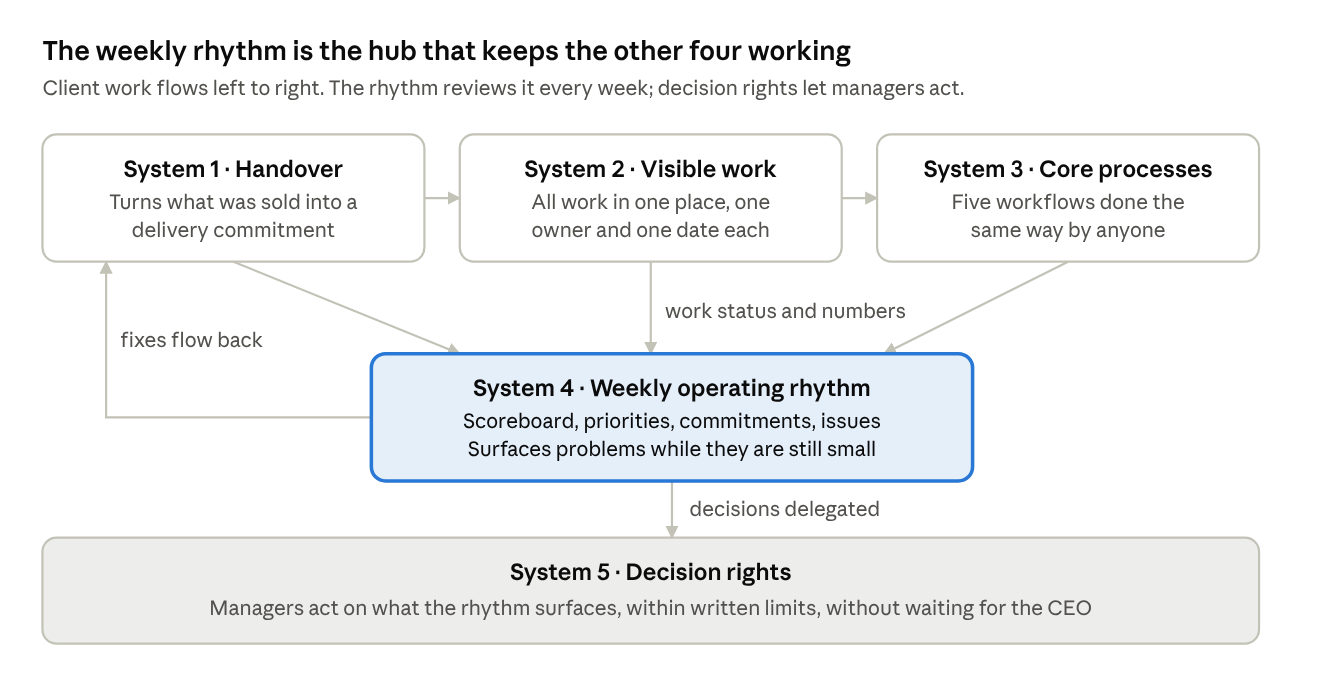
how the five systems connect · one hub, one foundation
Client work moves from handover to visible work to documented delivery. Every week the rhythm reviews that flow through the scoreboard, and decision rights let managers fix what it surfaces without routing back through the CEO.
Why the dependencies matter:
-
The rhythm without visible work reviews opinions, not facts.
-
Visible work without a rhythm becomes a well-organised list nobody acts on.
-
Processes without decision rights still escalate every exception to the CEO.
-
Decision rights without a scoreboard feel like a loss of control, so the CEO takes them back.
-
A handover without a feedback loop documents scope creep but never reduces it.
This is why the build sequence starts with the rhythm: it is the one system that keeps the other four honest.
The 90-day build sequence
Do not build all five systems at once. Teams that try usually finish none. The default sequence below builds the rhythm first, because the weekly meeting is where every other system gets reviewed, enforced and improved.
The default sequence
| Phase | Weeks | Build | Why this order | Done when |
|---|---|---|---|---|
| 1. Rhythm | 1–3 | System 4: choose the five numbers, set the meeting, start the commitments log | Creates the place where every other system is tracked | Three consecutive meetings held, on time, with a scoreboard |
| 2. Visibility | 2–8 | System 2: one tool, intake form, owners and dates, leadership view | Without visible work, the rhythm reviews guesses | 90% of live work in the system; intake channel in use |
| 3. Handover | 4–8 | System 1: template, handover meeting, CRM gate | Usually the fastest margin win | Every new client since week 6 has a handover |
| 4. Decisions | 6–12 | System 5: two-week decision log, matrix, spending limits | Requires visibility and rhythm to be safe | Matrix published; CEO decision count falling week on week |
| 5. Processes | 8–13 | System 3: choose the five, document current reality, embed in onboarding | Lasts longest; benefits from the clarity the first four create | Five processes documented, owned, and used to train the next hire |
Phases overlap deliberately. Each one needs a named owner on the leadership team — not the CEO for all five.
When to change the order
Use your scorecard. Two common exceptions:
-
Margin is the urgent problem. If projects routinely overrun or clients dispute what was agreed, start System 1 in week 1 alongside the rhythm.
-
The CEO is the bottleneck. If decisions are visibly queuing and the CEO is working unsustainable hours, bring System 5 forward to week 3. Start with spending and concession limits only.
What to expect
-
Weeks 1–4: friction. The new disciplines feel slower than the old informal ways. Some people will quietly route around them. This is the point most implementations stall.
-
Weeks 5–8: the first visible wins. Fewer surprises in the weekly meeting. Fewer “quick questions” to the CEO. The first scope conversation that goes well because the handover was clear.
-
Weeks 9–13: compounding. The systems start reinforcing each other. The scoreboard shows where processes are failing; decision rights mean managers fix them without escalation.
Capacity: be realistic
Plan on roughly two to four hours a week from each system owner during the build, and more from whoever leads the overall programme. If nobody on your team has that capacity, the build will slip quarter after quarter. That is the most common reason businesses bring in outside operational leadership: not because the systems are hard to design, but because nobody inside has the time to install them while running the business.
The business case in CFO language
Operational systems are easy to postpone because their cost is hidden. This worksheet makes it visible. Use your own figures; conservative estimates are fine. The point is to replace “we should get more organised” with a number your board or finance lead can weigh.
The margin-leakage worksheet
| Line | Leakage source | How to estimate it | Your annual figure (£) |
|---|---|---|---|
| A | Unbilled scope (System 1) | Average hours over sold scope per client × number of clients a year × loaded hourly cost | |
| B | Rework (Systems 1 and 3) | Hours spent redoing work a year × loaded hourly cost. Ask delivery leads to estimate a typical month and multiply by 12. | |
| C | Senior time on routine work (Systems 3 and 5) | Hours a week senior people spend on tasks a junior person could do with documentation × 46 weeks × the difference in their hourly costs | |
| D | CEO time on routine decisions (System 5) | Hours a week the CEO spends on decisions others could make × 46 weeks × the value of a CEO hour (use their share of profit, not their salary) | |
| E | Missed deadlines and lost clients (Systems 2 and 4) | Clients lost in the last year where delivery problems were a factor × average annual client value × gross margin % | |
| F | Slow onboarding (System 3) | New hires a year × months to full productivity beyond what it should be × monthly loaded cost × 50% | |
| Total annual leakage | A + B + C + D + E + F |
How to read it. In our experience, most £3–10M businesses that complete this honestly find a total that exceeds the cost of fixing it several times over. Your result may be higher or lower; the exercise only works with your own numbers.
The enterprise-value angle
The worksheet measures annual profit lost. There is a second, larger number. Buyers and investors discount businesses that depend on their owner, because the risk walks out of the door with the CEO. Documented processes, a management team that holds decision rights, and a scoreboard with a track record are exactly what due diligence looks for.
If an exit, an investment round or a succession is anywhere on your three-to-seven-year horizon, these five systems are not overhead. They are part of what you are building to sell.
Framing it for your board or finance lead
Present the investment the way you would any capital decision:
-
Cost: internal time from system owners, any tool licences, and any outside support.
-
Return: recovered leakage from the worksheet, phased in over two to three quarters as the systems embed.
-
Payback: cost divided by monthly recovered leakage.
-
Strategic value: growth capacity without proportional headcount, reduced key-person risk, and a more valuable business.
Be conservative on the return. Credibility with a finance audience comes from under-promising.
Where implementations stall
The five systems are well understood. Most businesses that attempt them still stall. The reasons are predictable, and almost none of them are about design.
| Stall point | What it looks like | What prevents it |
|---|---|---|
| The CEO owns everything | Every system is “the CEO’s project.” When the CEO gets busy, all five stop. | One named owner per system from the leadership team. The CEO sponsors; others build. |
| The tool becomes the project | Weeks spent configuring software; nobody changes how they work. | Design on paper first. Give the tool a two-week setup limit. Measure behaviour, not configuration. |
| The week-four dip | The new disciplines feel slow; people drift back to messaging and corridor decisions. | Expect it. Leaders model the new behaviour visibly and redirect off-system requests every time. |
| Leaders exempt themselves | Managers use intake; the CEO still assigns work by WhatsApp. | The CEO goes first, publicly. Any exception becomes the rule. |
| Perfect over working | Processes rewritten five times before anyone uses them; scoreboard numbers debated for a month. | Ship the 80% version. Improve it in the quarterly review. |
| No rhythm to sustain it | Systems built, then quietly decay within two quarters. | System 4 first. The weekly meeting is where the other four get checked. |
| No capacity to build | Everyone agrees it matters; nobody has the hours. The project rolls over quarter after quarter. | Ring-fence time explicitly, or bring in someone whose job is to install it. |
The honest test
Ask yourself one question before you start: who, by name, will own this programme for the next 90 days, and what will they stop doing to make room for it? If you cannot answer both parts, the build will stall. Better to know that now and plan for it than to discover it in week six.
Next step: from diagnosis to an operating system
You now have the scorecard, the five specifications and a 90-day sequence. Many leadership teams can build these systems themselves, and this guide is written so you can.
Where teams usually need help is not the design. It is the installation: holding the line through the week-four dip, owning the programme while the leadership team runs the business, and making the systems stick when the old habits push back.
What Markinly does
Markinly International Management provides fractional COO leadership to businesses in the £1M–£20M range across the UK, US and Europe. We embed with your leadership team, diagnose where the operating model is breaking, and install the systems in this guide — then hand them over to people who own them.
Our work combines boardroom-level strategy with hands-on execution: the same person who designs your decision-rights matrix sits in your weekly meeting making sure it is used.
The Scale Readiness Review
Complete the scorecard with your leadership team, then book a 45-minute review. In that call we will:
-
Walk through your scores and the gaps between your leadership team’s answers.
-
Identify the one system that is costing you most right now.
-
Outline a realistic build sequence for your stage and your team’s capacity.
You leave with a clear priority and a plan, whether or not we work together.
Book your review: [booking link] · Visit: [website]
About the author. Gideon is the founder of Markinly International Management and a fractional COO with more than 20 years of operational leadership across professional services, e-commerce, retail and real estate. He works with CEOs and business owners whose companies have outgrown the way they are run.
Put this to work
The fastest way to apply it to your business: a free 60-minute Ops Diagnostic.
Get the guide
Related resources
 Insight
How to delegate decisions without losing control
A practical decision-rights framework for founders who've become the bottleneck.
 Insight
Building accountability without micromanaging: the operating rhythm that works
Most CEOs who complain about accountability don't have a people problem. They have a missing structure — and they are filling the gap with…
Recently viewed
Reading is good. A diagnosis is better.
Start where every client starts: the free 60-minute Ops Diagnostic.